
How Artificial Intelligence Is Changing Daily Life
Introduction
Artificial Intelligence (AI) has become a part of daily life across homes, workplaces, schools, hospitals, and online platforms. Many people use AI without realizing it because it operates behind the applications and devices they interact with every day. From voice assistants and recommendation systems to automated customer support and navigation services, AI is changing the way people communicate, work, learn, shop, and manage their routines.
The development of AI technologies has increased access to information and digital services. Businesses use AI to improve operations, while individuals use AI tools to save time and complete tasks more efficiently. As AI continues to develop, understanding its role in everyday life helps people make better decisions about how they use technology.
This article explores how artificial intelligence is changing daily life, the areas where AI has the greatest impact, its benefits, challenges, and what the future may hold.
Understanding Artificial Intelligence
Artificial Intelligence refers to computer systems designed to perform tasks that typically require human intelligence. These tasks include learning from data, recognizing patterns, understanding language, making decisions, and solving problems.
AI systems rely on algorithms and large amounts of data to identify relationships and improve their performance over time. Different types of AI applications serve different purposes, including speech recognition, image analysis, language translation, and predictive systems.
Today, AI is available through smartphones, websites, software applications, and connected devices, making it a common part of daily activities.
AI in Communication
Communication has changed significantly through the use of AI. Many messaging platforms and email services use AI to provide features such as predictive text, grammar correction, translation, and spam detection.
Voice assistants allow users to make calls, set reminders, search for information, and control devices using spoken commands. AI-powered chat systems provide customer support by answering questions and guiding users through services at any time of the day.
These technologies help individuals and organizations communicate more quickly and manage information more effectively.
AI in Education
The education sector has adopted AI to support students and teachers. Learning platforms use AI to analyze student progress and provide lessons based on individual needs.
Students can access AI-powered study tools that explain concepts, summarize information, create practice questions, and help with research. Teachers use AI for administrative tasks such as grading assignments and organizing educational materials.
Online education has also expanded with AI-based recommendations that suggest courses and learning resources according to a student’s interests and progress.
AI in Healthcare
Healthcare is one of the areas where AI has created significant changes. Medical professionals use AI systems to analyze medical images, assist in disease detection, and organize patient records.
Wearable devices powered by AI can monitor physical activity, heart rate, sleep patterns, and other health-related data. This information helps users understand their habits and allows healthcare providers to monitor patient conditions more effectively.
AI also supports medical research by analyzing large datasets and identifying patterns that can contribute to the development of new treatments.
AI in Transportation
Transportation has become more efficient through AI technologies. Navigation applications use AI to analyze traffic conditions, suggest routes, and estimate travel times.
Ride-sharing services use AI algorithms to connect drivers with passengers and calculate pricing based on different factors.
Vehicle manufacturers continue to develop AI-based systems for driver assistance, including lane monitoring, collision alerts, and parking assistance.
AI in Shopping and E-Commerce
Online shopping experiences are heavily influenced by artificial intelligence. AI analyzes customer behavior, previous purchases, and search history to provide product recommendations.
Retail companies use AI to manage inventory, predict demand, and improve customer service through automated chat support.
AI also helps detect fraudulent transactions, creating safer payment experiences for consumers.
AI in Entertainment
Entertainment platforms use AI to recommend movies, television shows, music, and other content based on user preferences.
Streaming services analyze viewing and listening habits to suggest content that matches individual interests.
AI is also used in gaming, content creation, and digital media production, allowing companies to create interactive experiences for audiences.
AI in the Workplace
The workplace has experienced major changes because of AI automation. Businesses use AI to manage repetitive tasks, analyze information, and support decision-making.
Common workplace uses of AI include:
- Data analysis and reporting
- Customer support automation
- Document processing
- Scheduling and planning
- Cybersecurity monitoring
- Content generation
By reducing time spent on repetitive work, employees can focus on tasks requiring creativity, strategy, and human interaction.
AI in Personal Finance
Financial institutions use AI to improve banking services and security. AI systems monitor transactions to identify suspicious activity and prevent fraud.
People use AI-powered financial applications for budgeting, expense tracking, investment analysis, and financial planning.
These tools help users understand spending habits and make informed financial decisions.
AI in Smart Homes
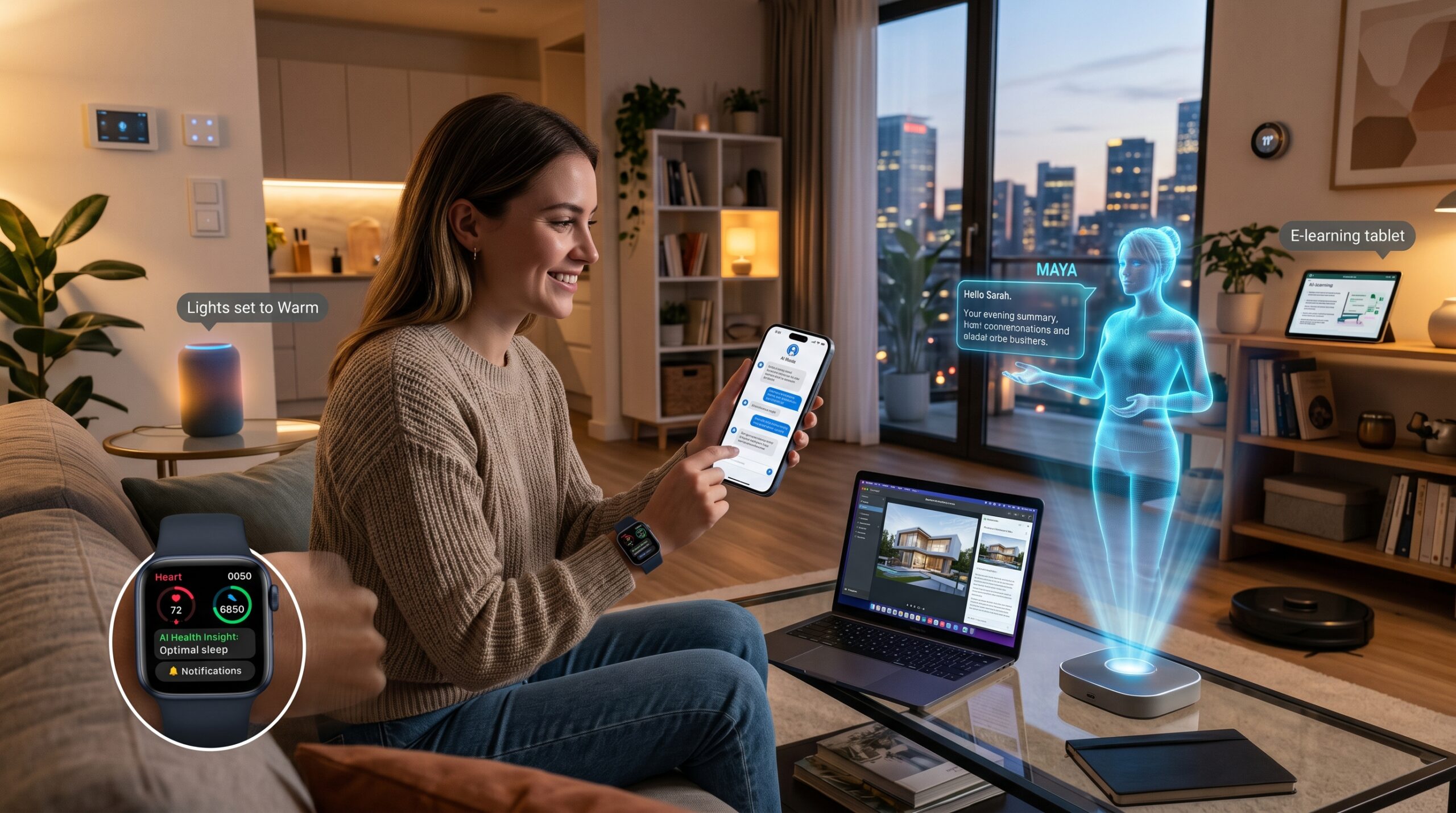
Smart homes represent another area where artificial intelligence plays an important role. AI-enabled devices can automate lighting, temperature control, security systems, and household appliances.
Smart assistants can understand voice commands and perform tasks such as setting alarms, playing music, providing weather updates, and controlling connected devices.
Home automation continues to grow as more devices become connected through the Internet of Things (IoT).
AI and Social Media
Social media platforms use AI to organize content, recommend posts, identify harmful activity, and personalize user experiences.
AI systems analyze user interactions to determine which content appears in feeds. They also help detect fake accounts, inappropriate content, and security threats.
Businesses use AI tools on social media to analyze audience behavior and improve marketing strategies.
Benefits of Artificial Intelligence in Daily Life
Artificial intelligence offers many advantages, including:
Increased Efficiency
AI completes tasks quickly and helps individuals manage time more effectively.
Improved Accessibility
Voice recognition, translation tools, and assistance technologies help more people access digital services.
Better Decision Making
AI provides data analysis and insights that support personal and professional decisions.
Personalized Experiences
Many digital services use AI to provide recommendations based on individual preferences.
Continuous Availability
AI-powered systems can operate at any time, providing assistance without interruptions.
Challenges of AI in Everyday Life
Despite its benefits, AI presents several challenges that society must address.
Privacy Concerns
AI systems often require large amounts of personal data, creating concerns about how information is collected and used.
Security Risks
AI technologies can become targets for cyberattacks if security measures are not properly implemented.
Employment Changes
Automation may replace certain tasks, requiring workers to develop new skills and adapt to changing industries.
Dependence on Technology
Heavy reliance on AI may reduce human involvement in some areas of daily decision-making.
The Future of Artificial Intelligence in Daily Life
The role of artificial intelligence is expected to increase in the coming years. Future developments may improve healthcare services, transportation systems, education methods, and workplace productivity.
AI technologies may become more integrated into homes, devices, and online services. However, responsible development and proper regulations will remain necessary to ensure AI benefits society while protecting privacy and security.
Understanding AI and learning how to use it effectively will become an important digital skill for future generations.
Conclusion
Artificial Intelligence is changing daily life by influencing how people communicate, learn, work, travel, shop, and manage their homes. It has created new opportunities for efficiency, accessibility, and personalized services.
While AI provides many advantages, it also brings challenges related to privacy, security, and the changing nature of work. A balanced approach to AI development and usage will help society gain the benefits of this technology while addressing its risks.
As AI continues to evolve, individuals who understand and adapt to these technologies will be better prepared for a world where artificial intelligence plays an increasing role in everyday activities.
Frequently Asked Questions (FAQs)
1. What is artificial intelligence in simple words?
Artificial intelligence is a technology that allows machines and software to perform tasks such as learning, understanding language, analyzing data, and making decisions.
2. How do people use AI every day?
People use AI through smartphones, voice assistants, online shopping recommendations, navigation apps, social media platforms, and customer support chat systems.
3. Is artificial intelligence replacing human jobs?
AI can automate some tasks, but it also creates new opportunities that require human skills, creativity, and management.
4. How does AI improve healthcare?
AI helps healthcare providers analyze medical information, detect diseases, monitor patients, and support medical research.
5. Is AI safe to use?
AI can be safe when used with proper security, responsible data handling, and awareness of privacy risks.
6. What is the future of AI in daily life?
AI will likely become more integrated into homes, workplaces, transportation, education, and digital services, creating new ways for people to complete everyday tasks.